In this post
Lorem ipsum dolor sit amet
Lorem ipsum dolor sit amet
FSA Eligible Items in 2026: 7 Surprising Expenses You Can Use Your Funds For
Each year, employees forfeit an estimated $3 billion in unused Flexible Spending Account (FSA) funds, according to the Employee Benefit Research Institute. For HR leaders, that’s a visibility problem as much as a benefits one.
When employees don’t understand what qualifies, they underuse the funds you’ve already allocated. Helping them understand how to use those dollars is one of the simplest ways to increase participation, reduce forfeitures, and reinforce the value of your benefits program.
This guide covers seven commonly overlooked FSA-eligible expenses, along with practical ways to communicate eligibility and help employees use their funds more effectively.
What are FSA-eligible items, and why do they matter?
A Flexible Spending Account (FSA) lets employees set aside pre-tax dollars to pay for qualified medical expenses, including secondary medical insurance premiums and deductibles. Because contributions are made before taxes, FSAs lower taxable income and reduce out-of-pocket healthcare costs.
FSA-eligible items include a wide range of healthcare expenses defined by the IRS, from routine costs like copays and prescriptions to less obvious categories like over-the-counter products, mental health services, and certain preventive care items. According to the 2026 Benepass Benchmarking Report, the majority of FSA expenses were for doctor visits (38%) and pharmacies or drugstores (20%).
In 2026, employees can contribute up to $3,400 to an FSA. That’s a meaningful amount of pre-tax value at risk if employees don’t fully understand eligible expenses.
Painting a clear picture for employees increases participation, improves perceived value, and reduces the end-of-year rush to spend down balances. When employees know what qualifies, they are more likely to use their benefits consistently throughout the year instead of treating FSAs as a one-time decision during open enrollment.
7 unexpected FSA-eligible items
Employees often worry about misusing funds like FSAs and health savings accounts (HSAs), so they may use them only for direct medical care, such as coinsurance payments, dental expenses, X-rays, and physical exams. However, FSAs can be used for wellness outside of the doctor’s office and pharmacy. Think nasal sprays, hand sanitizer, acupuncture, first aid supplies, daycare, and these examples:
1. Air purifier/humidifier
Air purifiers and humidifiers qualify as FSA-eligible items, but both devices require a Letter of Medical Necessity (LMN) from a healthcare provider before FSA funds can be used for reimbursement.
The IRS distinguishes between general comfort purchases and medical treatments, so if a doctor prescribes an air purifier to manage asthma or severe allergies—or recommends a humidifier for sinusitis or eczema—employees can use pre-tax FSA dollars for the purchase. HEPA-filter air purifiers that capture airborne allergens can also qualify when prescribed for respiratory conditions, and both cool-mist and warm-mist humidifiers are eligible when recommended for sinus or skin issues.
Replacement filters and wicks may require separate LMNs depending on your plan design, which could add ongoing costs for employees with chronic medical conditions.
Cost: Prices typically range from $50 for basic humidifiers to $300 or more for advanced air purification systems.
Internal promotion: Promote these items during open enrollment or seasonal allergy peaks to give employees a timely reason to ask their provider about an LMN.
2. Sunscreen
Sunscreen is one of the most practical FSA-eligible items you can promote. No LMN is required, and the only rule is that the product must be SPF 15 or higher.
Broad-spectrum sunscreens that protect against UVA and UVB rays qualify as preventive care under IRS Code Section 213(d). This includes lotions, sprays, sticks, mineral formulas containing zinc oxide or titanium dioxide, tinted sunscreens with sun protection as the primary purpose, and lip balms with SPF 15 or higher.
But tanning oils and products marketed primarily for cosmetic purposes don't qualify, even if they contain some SPF.
Cost: Most FSA-eligible sunscreens cost between $10 and $30 at retailers like CVS, Walgreens, Target, and Ulta.
Internal promotion: When you're building year-end FSA spending reminders, include sunscreen as an easy, relatable example that shows employees how their pre-tax account covers everyday essentials.
3. Skincare
Medicated skincare products for diagnosed conditions like acne, eczema, rosacea, and psoriasis are FSA-eligible, and employees often don't realize this category extends well beyond prescription treatments.
Over-the-counter products from brands like CeraVe, Eucerin, and Aveeno that contain active therapeutic ingredients, such as ceramides, colloidal oatmeal, salicylic acid, or benzoyl peroxide, qualify for treatment of a specific skin condition rather than general beauty maintenance. Acne patches, spot treatments, ointments, and barrier repair creams for eczema are all fair game.
The key distinction: a moisturizer labeled "anti-wrinkle" won't qualify, but the same brand's "eczema therapy" formula will. Some items, like aloe vera gels, may require an LMN depending on the health plan design.
Cost: Prices vary by product size and type, typically between $10 and $30.
Internal promotion: Consider sharing a curated list of commonly eligible brands during open enrollment to reduce guesswork throughout the year, though advise employees to check with your FSA administrator when they're unsure.
4. Heating pads
Heating pads are FSA-eligible under IRS Code Section 213(d) when used for medical treatment rather than general relaxation, making them a practical item to highlight for employees dealing with back pain, muscle tension, or menstrual cramps.
Specialized formats, such as neck and shoulder wraps or lumbar pads, are also eligible. Brands like Sunbeam and Thermacare offer verified eligible products available at major pharmacy retailers and FSA-specific online stores.
Most plans don't require an LMN for standard heating pads, but employees should keep itemized receipts and be ready to document the medical purpose if their administrator requests it.
Cost: Electric heating pads with adjustable settings typically run $20 to $50, while microwaveable heat packs are usually $10 to $30.
Internal promotion: Include heating pads in your FSA education materials, such as a benefits guide or lunch-and-learn, to help employees connect everyday pain management to their pre-tax accounts.
5. Glasses
Prescription eyewear is one of the highest-value FSA-eligible purchases employees can make, yet many don't think to use their FSA card for vision expenses.
Employees can use FSA funds for frames, lenses, prescription sunglasses, and contact lenses. For non-prescription options like reading glasses or blue light–blocking glasses, no LMN is required. But prescription eyewear does require submitting the prescription along with the receipt.
Many vision retailers, both online and in-store, accept FSA cards directly at checkout, which removes the friction of manual claims submission. FSA funds also cover dependents' eyewear, making this especially valuable for employees with children or aging parents who need regular prescription updates.
Cost: A $300 pair of prescription eyeglasses purchased with FSA funds saves an employee roughly $90 to $120 in taxes, depending on their bracket.
Internal promotion: Highlight this during open enrollment or year-end reminders to meaningfully boost utilization.
6. Thermometers
Thermometers are straightforward FSA-eligible medical devices that don't require an LMN, making them among the easiest items to promote in your benefits communications.
Employees can use FSA funds to purchase digital thermometers, and standard retail receipts showing the product name, purchase date, and amount paid are generally sufficient for reimbursement, with no additional documentation required.
Cost: Prices typically range from $10 to $50 at major retailers like CVS and Walgreens.
Internal promotion: Use thermometers as an example to illustrate how FSA accounts are practical tools for everyday health monitoring, not just major medical events.
7. Shoe inserts
Orthopedic shoe inserts qualify as FSA-eligible when they're designed and marketed for therapeutic use, making them a practical option for employees dealing with plantar fasciitis, flat feet, or heel pain.
The eligibility rule is straightforward: inserts marketed for orthopedic or medical purposes qualify, while those labeled for athletic performance or general comfort don't. Employees should look for products with specific therapeutic features like arch support for overpronation, heel cups for plantar fasciitis, or metatarsal pads for forefoot pain.
Receipts should clearly show the product name and description, indicating the orthopedic purpose. Some administrators may request an LMN for higher-end models, so advise employees to verify before purchasing.
Cost: Over-the-counter inserts from brands like Dr. Scholl's, PowerStep, and Superfeet are available without a prescription and typically cost $15 to $60 per pair.
Internal promotion: Because inserts address a common source of workplace discomfort, include them in your year-end FSA spending reminders.
How to communicate FSA-eligible items to your workforce
Even the best FSA program falls short if employees don’t know how to use it. The goal isn’t more information. It’s timely, practical guidance employees can act on.
Start with these three steps to regularly remind and inform employees:
1. Build a year-round communication cadence
- Open enrollment: Share a simple “what qualifies” guide with real examples.
- Mid-year: Send balance reminders with seasonal items like sunscreen or allergy relief.
- Year-end: Highlight easy spend-down options employees can purchase quickly.
2. Use multiple formats to meet employees where they are
- Email communication: Send short emails with three to five examples of eligible items.
- Face-to-face interaction: Schedule lunch-and-learns focused on real scenarios instead of IRS language.
- Quick updates and messages: Plan and send Slack or intranet posts tied to seasonal needs.
3. Make it easy to take action
Instead of listing rules, show employees what to do next:
- “Have allergies? Ask your doctor about an LMN for an air purifier.”
- “Spending down your balance? Sunscreen and thermometers qualify.”
Platforms like Benepass reinforce these efforts by giving employees a clear, real-time view of eligible expenses and balances in one place, reducing confusion and increasing usage.
Common FSA eligibility mistakes HR teams must avoid
Small misunderstandings can lead to denied claims, employee frustration, and unused funds, such as:
- Unclear documentation requirements: Employees often submit incomplete receipts or miss required LMNs. Set expectations early on what’s needed for reimbursement.
- Confusion around over-the-counter medications: While many over-the-counter (OTC) medications are eligible, supplements and vitamins usually aren’t unless prescribed. This is one of the most common sources of denied claims.
- Mixing up FSA types: Medical FSAs and dependent care FSAs cover entirely different expenses. When employees confuse the two, claims get rejected, and trust erodes.
- Waiting until year-end to educate employees: If employees only hear about eligibility in December, they’re more likely to rush purchases or forfeit funds.
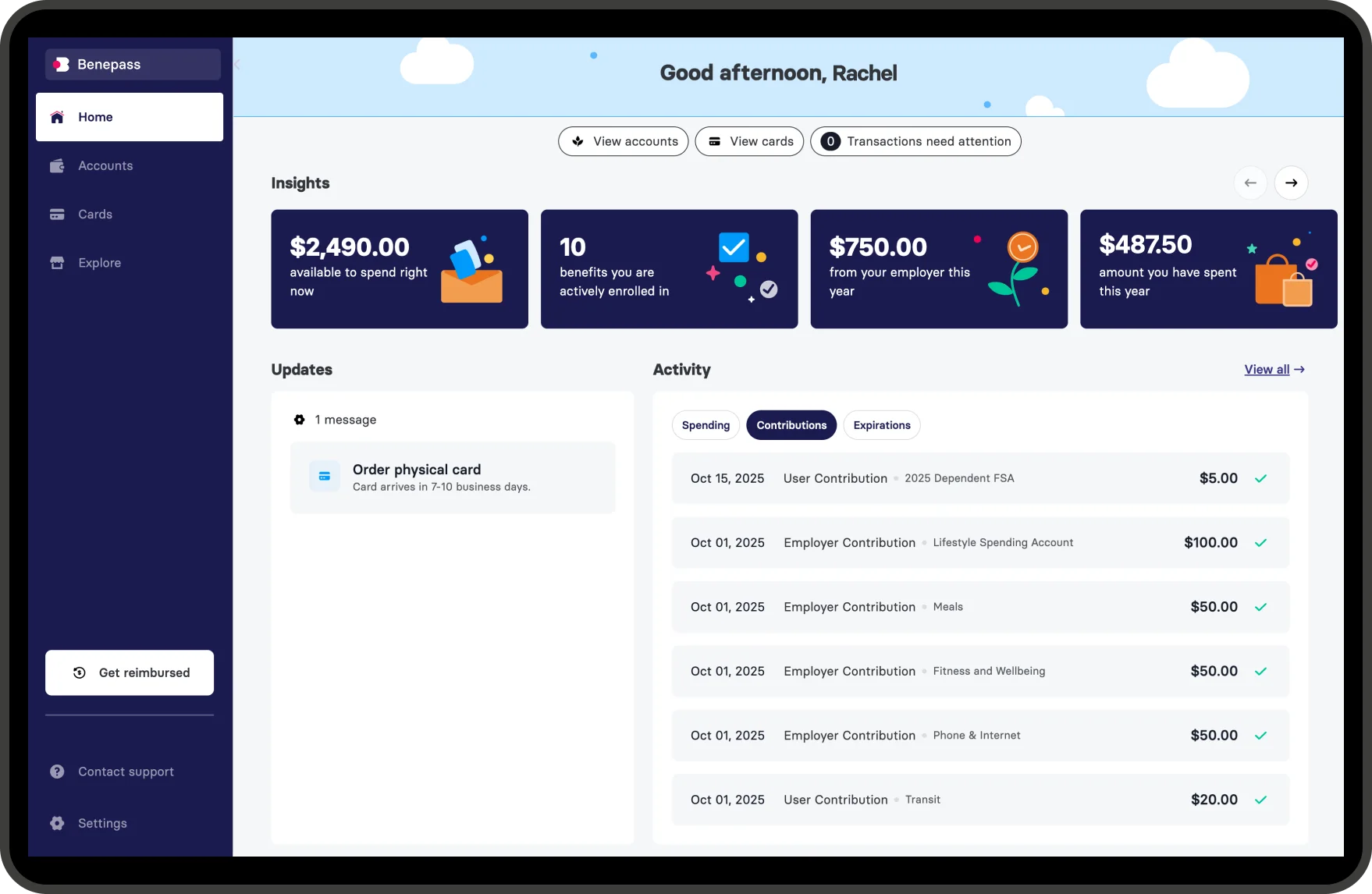
Modern FSA platforms help prevent these issues by guiding employees at the point of purchase, flagging documentation requirements early, and making eligibility easier to understand. For HR teams, that means fewer escalations and a program employees can use with confidence.
Frequently asked questions about FSA-eligible items
Can employees use FSA funds for over-the-counter medications?
Yes. Since 2020, the CARES Act has allowed employees to purchase over-the-counter medications with FSA funds without a prescription. This includes pain relievers, allergy medications, cold and flu treatments, and antacids. General health supplements and vitamins (unless prescribed) still don't qualify, so employees should verify eligibility before purchasing to avoid denied reimbursements.
What documentation is required for FSA reimbursement claims?
FSA reimbursement claims require an itemized receipt showing the purchase date, merchant name, item description, and amount paid. Credit card statements alone aren't sufficient. For items like air purifiers or therapeutic skincare, employees may also need an LMN from their healthcare provider.
Your FSA administrator sets the specific documentation standards, so communicating these requirements clearly during open enrollment reduces back-and-forth later.
How can HR teams help employees avoid losing unused FSA funds?
Proactive communication throughout the year, not just during open enrollment, is the most effective approach. Send quarterly balance reminders, share curated lists of eligible items, and host mid-year and year-end spending campaigns. If your plan includes a grace period or carryover provision, explain exactly how it works and what employees need to do.
Platforms that consolidate FSA management with other pre-tax accounts make it easier for employees to track balances in real time and act before funds are forfeited.
How modern FSA platforms simplify eligible item management
Helping employees understand what qualifies for FSA reimbursement is one of the simplest ways to increase utilization and reduce forfeitures. The seven items above are just a starting point. The real impact comes from keeping eligibility clear and top of mind year-round.
Benepass brings FSA management together with other pre-tax employee benefits in one place, so employees can easily track balances and understand what they can spend them on without digging through IRS guidance. For HR teams, that means fewer questions, cleaner documentation, and a program employees actually use.
Explore how Benepass supports FSA administration at scale and get in touch today.

Frequently Asked Questions


Rebecca Noori
Rebecca Noori is a freelance HR Tech and SaaS writer who is obsessed with our world of work. She writes about everything from employee benefits and performance management to upskilling and productivity tips. When she's not writing, you'll find her grappling with phonics homework and football kits, looking after her three kids.